


MIMO testing for Bluetooth and Wi-Fi
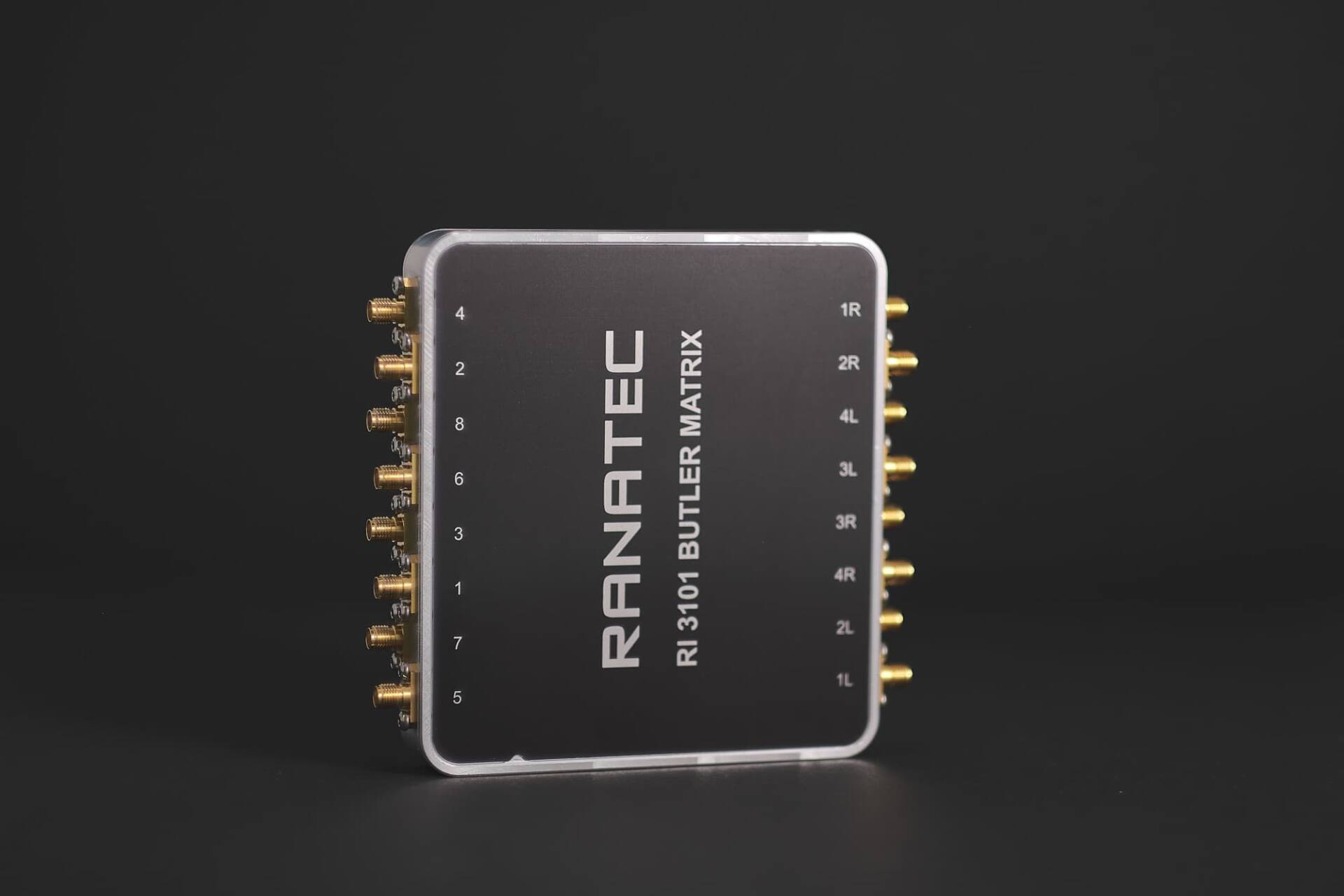
The RI 3101 Butler Matrix supports multichannel MIMO testing for 8+8 antenna ports over a large frequency range – the conventional Bluetooth and Wi-Fi bands at 2.4 and 5 GHz are supported as well as an extension up to 8 GHz.
Beam switching and beam steering
The RI 3101 Butler Matrix controls the direction of your antenna beam, using spatial filtering, creating directional signal transmission or reception. Beam switching (steering the beam) is achieved by altering the input power port, 1-8. Typically a switch matrix is applied in front of the Butler Matrix to control the power input.
The Ranatec Butler Matrix is designed for high precision applications, where high isolation and low out-of-phase is of importance.
The resulting antenna beam steering and butler matrix beamforming will consequently have high accuracy and suitable for the most demanding applications.
The RI 3101 Butler Matrix simulates real-world conditions, directing coverage over distances and across obstacles. This enables true testing of smartphones, sensors, routers and other access points. The RI 3101 Butler Matrix plays an important role in development of Wi-Fi 6 products.
Wi-Fi 6 is the most recent Wi-Fi network protocol and is a substantial upgrade over its predecessor. Wi-Fi 6 is faster due to technologies like traffic prioritization, beamforming and OFDMA. OFDMA (Orthogonal Frequency Division Multiple Access) works by subdividing channels into subcarriers and allowing for transmission to multiple endpoints (devices) at the same time. A Wi-Fi 6 router can send different signals in the same transmission window.
This results in a single transmission from the router being able to communicate with several devices, instead of each device having to wait for its turn as the router serves up the data across the network.